Victor is a 48-year-old man who is retiring from the Canadian Armed Forces after serving 20 years of active duty, including multiple tours overseas. He has seen active combat throughout his military career and is a right-handed shooter. He was placed on brief medical leave after the diagnosis of post-traumatic stress disorder (PTSD) was made after close exposure to an improvised explosive device in Afghanistan. He has experienced an increasingly pervasive tinnitus that he perceives throughout the day and that worsens in quiet environments. He is having difficulty falling asleep because of the tinnitus. Serial audiograms over his military career have documented a progressive, bilateral noise-induced hearing loss that is worse in his left ear.
Victor’s tinnitus is managed with a trial of binaural amplification, masking sound therapy at night, and counselling with a psychologist for PTSD and cognitive behavioural therapy to help Victor dissociate his tinnitus from his mental health concerns.
Tinnitus is the perception of noise in the absence of an environmental stimulus. It is a common symptom of an abnormally functioning auditory system due to inappropriate habituation of the auditory pathways in response to injury. It has a high prevalence (approximately 15,000 per 100,000 individuals) across the age range, with increased prevalence in the elderly due to a close association with hearing loss.
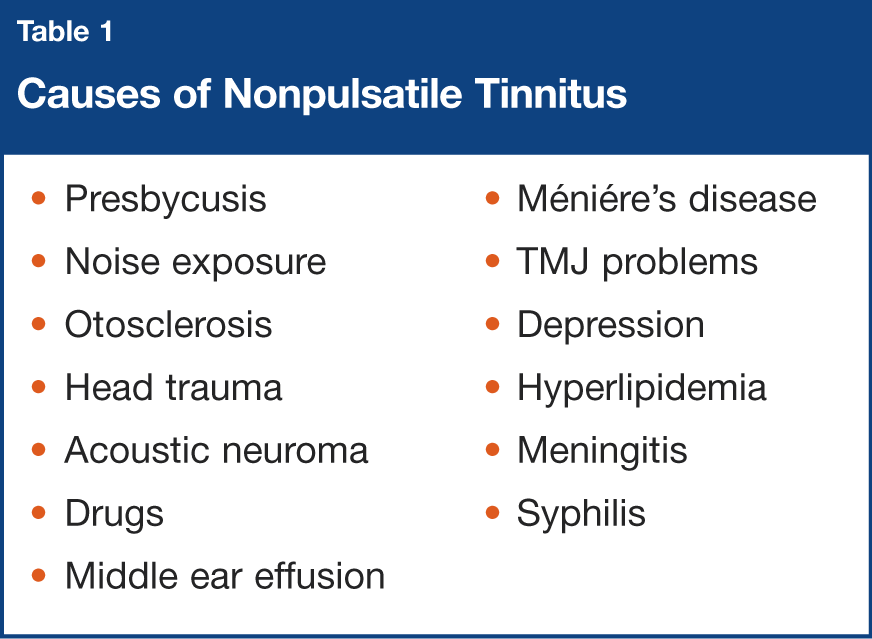
Nonpulsatile tinnitus is reported by the majority of patients (90% of cases) and is caused and influenced by many factors (see Table 1). Current theories about the etiology of tinnitus involve the formation of an initial tinnitus signal generated by an ignition site, most commonly due to inner ear hair cell injury. This signal is perceived abnormally as a sound by a central auditory mechanism (the promotion), and it can become a clinical problem if the central nervous system does not habituate normally and suppress the tinnitus.
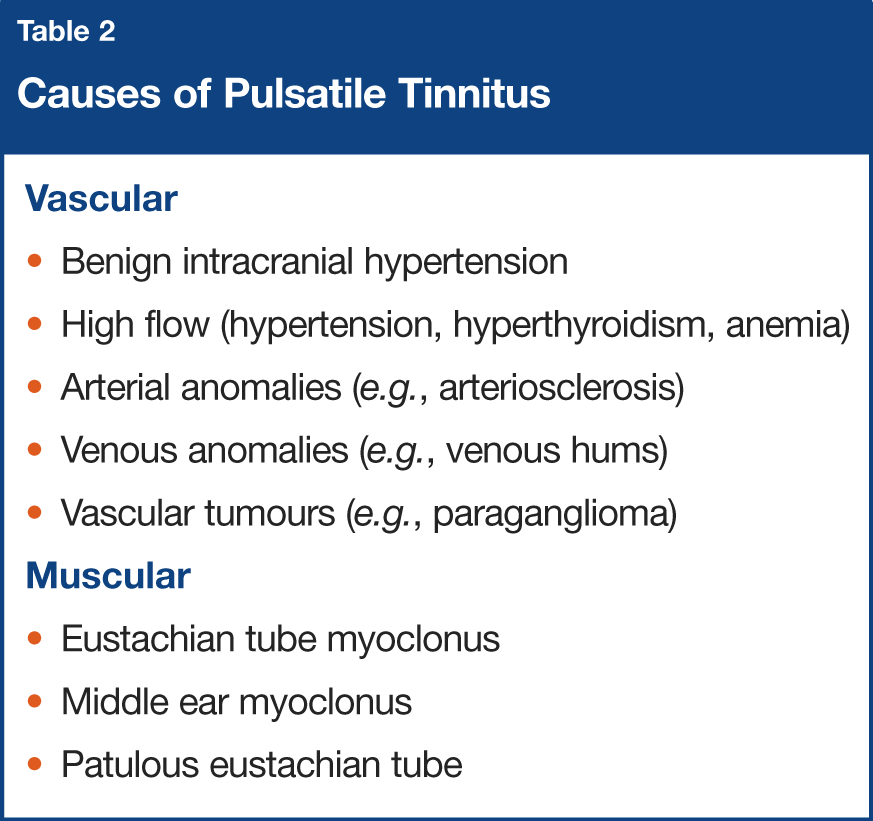
Pulsatile tinnitus is reported by patients in approximately 10% of cases. It can be classified as either subjective or objective depending on whether the sound can be auscultated on examination. Muscular pulsatile tinnitus is caused by rhythmic contractions of the muscles of the middle ear or eustachian tube. Vascular pulsatile tinnitus is caused by pathologies of the arterial and venous system in the head and neck (see Table 2).1
Primary care investigations for vascular pulsatile tinnitus should focus on excluding systemic disease (e.g., atherosclerotic carotid artery disease, hypertension, thyrotoxicosis, thrombocythemia, anemia), otologic disease (middle ear effusions, tumours), and CNS disease. Diagnostic imaging recommendations include magnetic resonance imaging with venography of the brain and skull base for venous tinnitus, CT angiography of the head and neck for patients with either arterial tinnitus or an abnormal otoscopic examination, or formal carotid angiography if there is a strong clinical suspicion that an intracranial arteriovenous fistula or malformation is present.
Reduction in life stress, promoting a regular sleep schedule, avoiding caffeine and stimulants, and reduction of noise exposure (occupational and recreational) should be undertaken to reduce the potential for acute or chronic trauma to the auditory system and to increase the potential for CNS habituation.
The majority of tinnitus cases are associated with hearing loss due to genetics or noise trauma, which increases in prevalence with advancing age. Amplification for hearing loss should be considered for those patients experiencing communication difficulties. Sound therapy and masking with white noise may benefit patients experiencing difficulties with tinnitus when in quiet environments or when trying to fall asleep.
ASA, NSAIDs, and quinine at high doses can be associated with a temporary, reversible tinnitus and/or hearing loss that usually settles after cessation of the medication, but it can be permanent in rare cases. Review the patient’s history and rule out the possibility of ototoxicity from treatments with chemotherapy agents, diuretics, or antibiotics.
Ear canal foreign bodies, cerumen impaction from Q-tip use, or a middle ear effusion from a recent ear infection are simple and common causes of tinnitus. Referral to an otolaryngologist-head and neck surgeon should be considered for patients with asymmetric symptoms, pulsatile tinnitus, or for suspected otologic disease, such as a chronic middle ear effusion, otosclerosis, Ménière’s disease, or vestibular schwannoma. The prevalence of vestibular schwannoma is an estimated 1 in 100,000 individuals, and the prevalence of Ménière’s disease is low at 2 in 1,000 individuals.2
Tinnitus can be experienced by patients with mental health diagnoses, such as depression and anxiety. Pharmacotherapy with antidepressants or anxiolytics can be prescribed to manage the underlying psychologic disorder, but there is little medical evidence supporting the use of medications as a primary treatment for tinnitus. Cognitive behavioural therapy has been found to be an effective treatment modality for managing tinnitus for some patients,3 and referral to psychology or psychiatry may be appropriate for these patients.
Two-thirds of patients with tinnitus will identify a somatosensory trigger influencing their tinnitus. Common triggers include temporomandibular dysfunction, bruxism, cervical spine injury, or myofascial pain syndromes.4 These should be considered particularly in patients whose audiometry is normal. Referral to physiotherapy, dentistry, massage therapy, or chiropractic therapy can be considered, depending on the patient’s symptoms, for definitive treatment.
1. Sismanis A: Pulsatile Tinnitus: Contemporary Assessment and Management. Curr Opin Otolaryngol Head Neck Surg 2011; 19(5):348–357.
2. Alexander TH, Harris JP: Current Epidemiology of Meniere’s Syndrome. Otolaryngol Clin North Am 2010; 43(5):965–970.
3. Martinez-Devesa P, Perera R, Theodoulou M, et al: Cognitive Behavioral Therapy for Tinnitus. Cochrane Database of Syst Rev 2010; 9:CD005233.
4. Sanchez TG, Rocha CB: Diagnosis and Management of Somatosensory Tinnitus: Review Article. Clinics (Soa Paulo) 2011; 66(6):1089–1094.
Presented at the University of Calgary’s Family Practice Review and Update in Calgary, Alberta, on November 19, 2012.