Paul, a 48-year-old, Caucasian male, asks about PSA testing during a routine visit. Paul’s 58-year-old brother was diagnosed with high-risk prostate cancer a year ago, and he is concerned about his family history.
After a thorough discussion regarding the risks and benefits of PSA testing, Paul decides to have a baseline PSA test and DRE. His DRE is normal, and his PSA is 4.5 ng/ml. He is counselled on having a urological consult and a biopsy, but he decides to have a repeat PSA test first. If PSA remains elevated, a biopsy is indicated. If PSA normalizes, he should be considered at risk due to his family history and should, thus, start annual screening.
Canadian prostate cancer screening guidelines have recently been challenged by data published on prostate cancer survivorship. The prostate-specific antigen (PSA) era has afforded practitioners a tool to weigh the risk of prostate cancer and minimize prostate cancer morbidity and mortality. Some question whether restricting PSA use and/or abandoning it altogether will reduce issues with overtreatment or result in more harm. The following is a critical look at available evidence that will help clarify the recommendations of the Canadian Task Force for Preventative Health (CTFPH) and assist primary care providers in counselling patients on PSA testing and its appropriate use.
According to the Canadian Cancer Society, prostate cancer is the most common male cancer and the third leading cause of male cancer death in Canada. Approximately 24,000 Canadian men were diagnosed with prostate cancer in 2015 (24% of newly diagnosed male cancers), and an estimated 4,100 men died from prostate cancer (10% of male cancer deaths). Approximately one in six men will die from prostate cancer.1
The PSA test emerged with wide acceptance in the 1990s to assist with early diagnosis of prostate cancer. Controversy arose with widespread use of PSA testing due to concerns about overtreatment of nonaggressive disease. Fear of overtreatment and screening harm has paralyzed the use of PSA testing and has raised doubts about its validity. The current aim of PSA testing is to uncover red flags associated with undiagnosed prostate cancer, document benign prostatic hyperplasia progression, and actively surveil for low-risk prostate cancer. New guidelines recently released by the CTFPH advocate against using PSA to screen for prostate cancer.2
The evidence on PSA testing really needs a second sober look, especially in light of emerging data. For instance, the argument is made that PSA testing has little effect on reducing prostate cancer-specific mortality (PCSM). However, the 14-year PCSM analysis of the Swedish Göteborg Trial demonstrates a 56% mortality reduction in the screened cohort.3 The Prostate, Lung, Colorectal, and Ovarian (PLCO) trial yielded different results; this was namely due to contamination of the control arm of the study (reported to be 52%).4 The control arm contamination occurred when control participants (who should not have undergone any screening) obtained PSA testing independent of the study (roughly half as often as the study arm), masking the screening effect of the PSA test.
The European Randomized study of Screening for Prostate Cancer (ERSPC) trial confirmed that reducing contamination also reduces PCSM with PSA testing; it reported a contamination rate of 23 to 40% in its control arm.5
The CTFPH, among others, advocates abandoning PSA testing; however, this approach removes the patient from the equation. The Melbourne Consensus Statement on Prostate Cancer Testing supports discussing PSA testing with patients as a part of an informed decision-making process.6 The recommendation is based on five significant points that should be considered when deciding on PSA testing:
• PSA testing reduces metastatic prostate cancer and PCSM
• Prostate cancer diagnosis should be divorced from intervention
• PSA is not a stand-alone approach but, rather, part of a multivariate approach to early prostate cancer detection
• Baseline PSA at age 40 helps predict future prostate cancer risk/aggressiveness
• Older men with a life expectancy < 10 to 15 years should have a modified PSA analysis based on comorbid status rather than a chronological age
A few other points will help you to better understand the concerns that have been raised over objections to PSA testing. The CTFPH comments that randomized trials do not show a decrease in overall mortality. This is misleading to the reader because none of the screening trials were powered to demonstrate a decrease in overall mortality. For example, a trial designed to have 80% power to detect a 50% decrease in cancer mortality at 10 years, from 1.0 to 0.5%, in a population with an overall 20% mortality at 10 years would have less than 10% power to detect a difference in all-cause death. Thus, the lack of an overall mortality reduction should not be considered a criticism. The document acknowledges that two of the higher-quality trials found a reduction in PCSM whereas four lower-quality trials found no difference between the screening and control groups. The contamination in the PLCO trial, which has been reported to be as high as 85%, among other flaws, means that PLCO should not be considered equivalent to the ERSPC study. In other words, the CTFPH observed that the strongest evidence revealed a reduction in prostate cancer death; however, the recommendation states that there is “conflicting evidence suggesting a small and uncertain potential reduction in prostate cancer mortality.”2(p.1229) The statement, which acknowledges a mortality reduction from screening observed in the robust trials, is at odds with the statement in the final recommendation that there is no clear evidence of a mortality reduction.
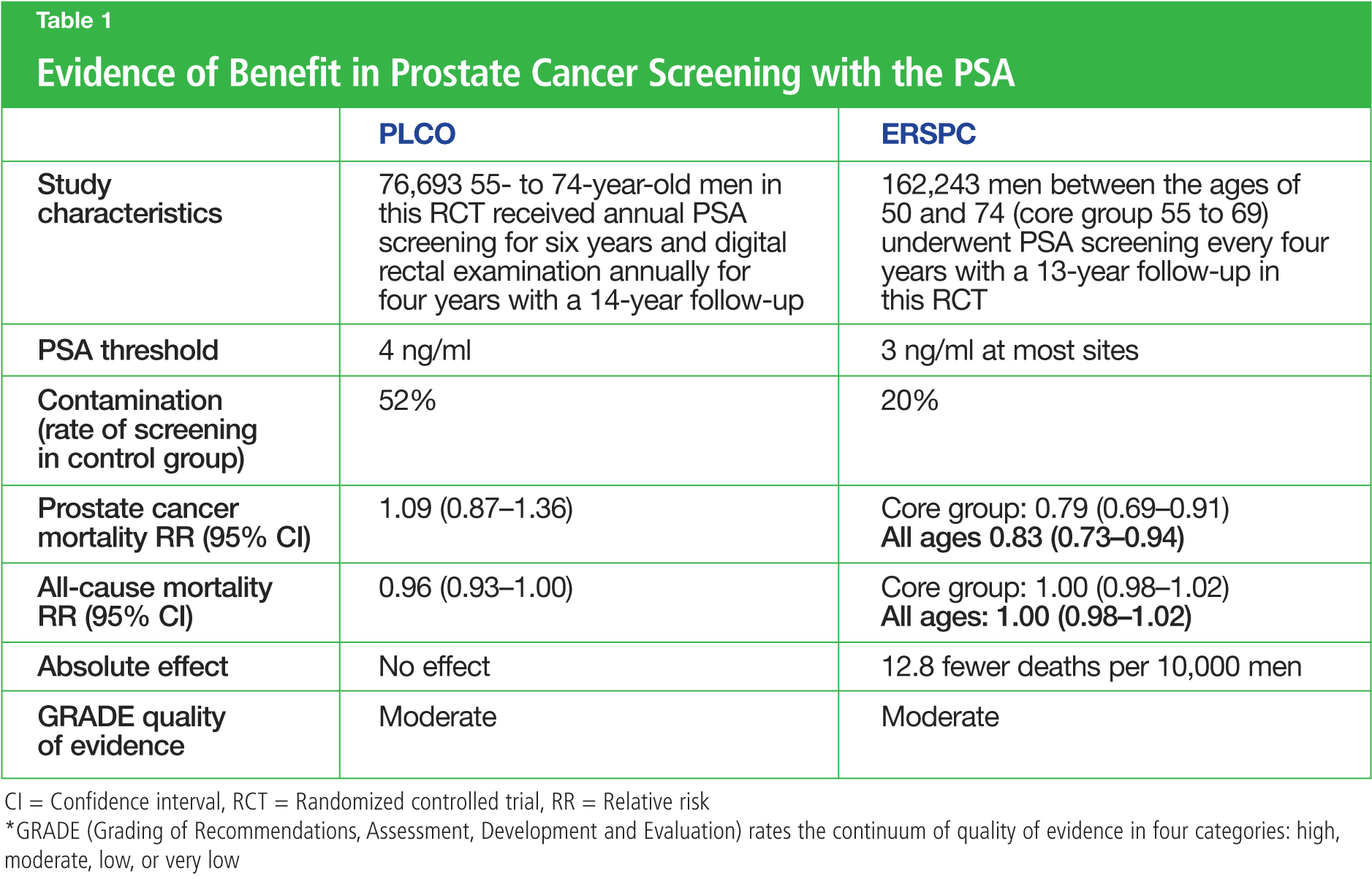
The review understates the benefits of screening, which it states as 1.28 deaths avoided per 1,000 men screened.2 The published report from the Göteborg randomized trial states that, as of a 14-year follow-up, the number-needed-to-diagnose for each death avoided was 12.4, and, in an analysis of healthy screened patients in PLCO, it was 5.0. The adjusted mortality reduction (corrected for noncompliance) in ERSPC was 27% at 13 years while the Task Force quoted the unadjusted rate of 21%. Evidence for a decrease in metastatic disease is also important to patients but was not included. Furthermore, the mortality curves in ERSPC and Göteborg continue to diverge with longer follow-up. While the expectation that more benefit will be demonstrated with longer follow-up should not drive current recommendations, it is reasonable that it influences the strength of these recommendations. The unsubstantiated claim that the reduction in mortality is unlikely due to screening and more likely due to advances in treatment is contrary to published evidence. Epidemiological modelling studies consistently ascribe 40 to 75% of the reduction in mortality to screening and only 20 to 33% to changes in treatment.7 Active surveillance has been widely adopted in Canada. This was not mentioned in the document. Clearly, the widespread use of surveillance for low-grade disease in Canada is relevant.
PSA screening has had a major impact on prostate cancer mortality, but it carries with it the risk of harm to patients who are unlikely to benefit. In the Canadian Urological Association’s view, the following recommendations are more appropriate for a Canadian population. PSA testing should be avoided in men with little to gain. After appreciating the potential risks and benefits, those men who do decide to have a PSA test and have a low value (< 1.0 ng/ml at baseline) should be tested infrequently (about every five years). Men with less than a 15-year life expectancy (typically over age 70) should not be screened unless they have previously had a high PSA. Men whose PSA is above the median for their age but below the biopsy threshold should be counselled for more regular screening and risk assessment. Digital rectal examination (DRE) has value for the detection of many anal and rectal problems, as well as prostatic abnormalities (including prostate cancer). Physicians should continue to perform DREs as a routine part of the periodic health exam. Do not treat men with low-risk prostate cancer or older men with intermediate-risk prostate cancer who are not likely to benefit from treatment.8
PSA tests are essentially snapshots, and, to fully understand the meaning of a single PSA, one should consider several PSAs over time (PSA trend or velocity). Fluctuations in PSA that return to baseline in three to six months should not warrant further investigation due to the PSA test’s sensitivity to irritation (e.g., DRE, sexual activity, inflammation, infection). A PSA that demonstrates a rising trend should be investigated with a urologist. PSA doubling time should be considered as well. A sustained short double time of 6 to 12 months could signal underlying pathology that can be sorted out with a urologist.
• All patients who want to be screened for prostate cancer should have a discussion about screening risks and benefits
• Patients over 70 and younger patients with a life expectancy < 15 years should not be screened
• At-risk populations should have their first screenings at age 40
• Populations that are not at risk should be screened between the ages of 55 and 69
• Any abnormal DRE should be followed by a confirmatory PSA
• A prostate biopsy is not without risk and physicians recommending it should confirm an abnormal PSA with clinical findings, repeat PSA levels, and risk stratification
• Patients found to have very low-risk prostate cancer (≤ 2 cores; < 50% Gleason 6) should be treated with active surveillance, thereby decreasing treatment side effects in the screened population
• The decision to undertake PSA testing should be made jointly with the patient after discussing benefits and risks
• PSA testing and DRE should be done together
• An elevated PSA test should prompt repeat testing in about a month
• Family history of high-risk prostate cancer at a young age has a strong correlation with prostate cancer risk
1. Prostate Cancer Statistics. Canadian Cancer Society. http://www.cancer.ca/ en/cancer-information/cancer-type/prostate/statistics/?region=sk. Accessed: August 15, 2015.
2. Bell N, Connor Gorber S, Shane A, et al: Recommendations on Screening for Prostate Cancer with the Prostate-specific Antigen Test. CMAJ 2014; 186(16):1225–1234.
3. Hugosson J, Carlsson S, Aus G, et al: Mortality Results from the Goteberg Randomised Prostate Cancer Screening Trial. Lancet Oncol 2010; 11(8):725–732.
4. Andriole GL, Crawford ED, Grubb RL, et al: Prostate Cancer Screening in the Randomized Prostate, Lung, Colorectal and Ovarian Cancer Screening Trial: Mortality Results after 13 Years of Follow-up. J Natl Cancer Inst 2012; 104(2):125–132.
5. Schröder FH, Hugosson J, Roobol MJ, et al: Screeing and Prostate Cancer Mortality: Results of the European Randomised Study of Screening for Prostate Cancer (ERSPC) at 13 Years Follow-up. Lancet 2014; 384(9959):2027–2035.
6. Murphy DG, Ahlering T, Catalona WJ, et al: The Melbourne Consensus Statement on the Early Detection of Prostate Cancer. BJU Int 2014; 113(2):186–188.
7. Etzioni R, Gulati R, Tsodikov A, et al: The Prostate Cancer Conundrum Revisited: Treatment Changes and Prostate Cancer Mortality Declines. Cancer 2012; 118(23):5955–5963.
8. Klotz L, Breau R, Chin J, et al: CUA Response to CTFHPC Recommendation on PSA Screening. Press Release. October 27, 2015. https://www.cua.org/ themes/web/assets/files/psa/cua_response_to_ctfphc_psa_oct__2014.pdf. Accessed: April 5, 2015.
Presented at Memorial University’s Focus Fridays: Urology/Radiology on January 30, 2015.